

From Japan to Sweden, and China to England: Reimagining a Japanese Porcelain Vessel with LEGO
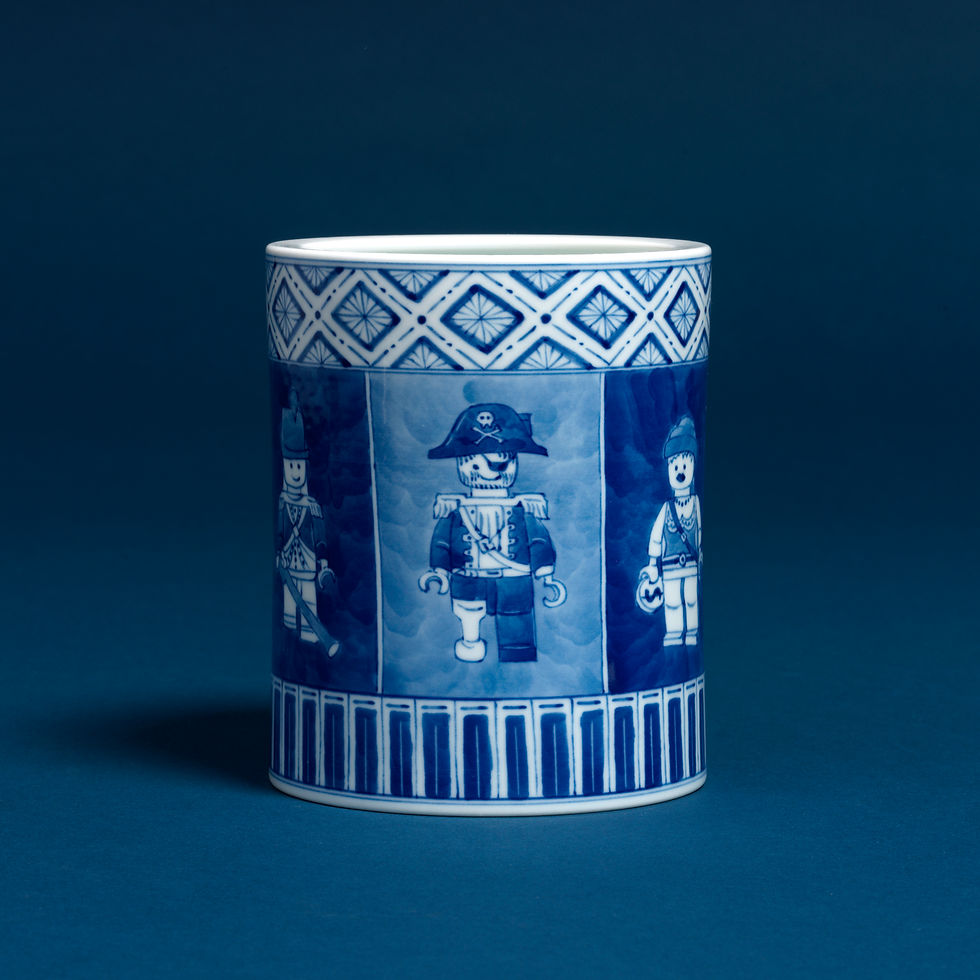
Sometimes, an encounter with an old object can lead somewhere quite unexpected. My LEGO pirate brushpot began with a business trip to Stockholm, a childhood memory, and one of my favourite pieces of Japanese porcelain.
An unexpected discovery in Stockholm
During a business trip to Stockholm, I visited the Museum of Far Eastern Antiquities. The museum was closed to the public at the time, but, knowing one of its curators, I was fortunate enough to be able to visit the collection.

There, I encountered a piece of Japanese porcelain that I had admired for years: a vessel decorated around its sides with wonderfully characterful figures of European men, probably Dutch traders. The museum identifies it as a brushpot, but when I later showed an image of it to a Japanese dealer, he suggested that it might actually be a hi-ire (火入れ), a vessel used to hold ash and burning charcoal, traditionally associated with smoking. Porcelain brushpots are relatively uncommon among Arita wares, which led him to question the original identification. Its precise function remains uncertain, but I found the possibility intriguing.
What captivated me most was the way the Japanese potter had depicted these foreign visitors. Their European dress and distinctive appearance had been translated into a charming, almost cartoon-like visual language. They were recognisably foreign, yet somehow familiar and approachable. I loved the wit of the figures and the way the artist had transformed cultural difference into something playful.
Dutch traders and Japanese porcelain
During the Edo period (1603–1868), Japan severely restricted its overseas contacts. The Dutch were the only Western Europeans permitted to maintain formal trade with Japan, operating through the Dutch East India Company at Dejima, an artificial island in Nagasaki harbour. Chinese traders also continued to play an important role in Japan's overseas commerce.

European visitors offered Japanese artists a rich source of visual inspiration. Their unfamiliar clothing, hats and distinctive features appeared in paintings, prints and decorative arts. Sometimes these figures were depicted with considerable humour, reflecting a fascination with people whose appearance and customs differed from those of the Japanese.
The porcelain vessel in Stockholm is a particularly appealing example of this interest. Its figures have a lively, almost theatrical quality, as though the artist were inviting us to share in the amusement of encountering these curious visitors from afar.
I wanted to do something with this object, but simply copying it would have missed the point. When I find inspiration in historical art, I prefer to take an idea and reinterpret it through my own experience. The challenge is to preserve something of the original's spirit while giving it a new identity.
From childhood pirates to porcelain
My answer came from an unlikely source: LEGO pirates.
One of my childhood memories is playing with LEGO pirate figures. Their hats, costumes and seafaring associations seemed to offer a surprisingly good counterpart to the seventeenth-century Dutch traders depicted on the Japanese vessel. Both conjured up a world of ships, distant shores and encounters between different cultures.

I began drawing a design that brought these familiar childhood figures into the world of traditional blue-and-white porcelain. The pirates would replace the original European figures, creating a playful connection between a historical Japanese object and a distinctly modern toy.
I sent my design to Fangfang, the painter I work with in Jingdezhen, China, to bring it to life on porcelain.
I gave her one particularly important instruction: I wanted the painting to feel handmade, not as though it had been generated by a computer. The lines did not need to be perfectly straight, nor did every detail need to be mechanically uniform. For me, there is a particular beauty in the irregularities of the human hand. Small variations give a painted object its character and vitality.
The finished brushpot combines the familiar blue-and-white palette of Chinese porcelain with the playful figures of LEGO pirates. Although it takes inspiration from a Japanese vessel, it is not an attempt to reproduce the original. Instead, it translates the historical object's spirit into a new visual language, shaped by my own memories and Fangfang's skill as a painter.
A conversation across continents and centuries
Looking at the finished brushpot, I am struck by how many different worlds have come together in a single object.
There is the Japanese porcelain that first inspired me, the Dutch traders whose appearance fascinated Japanese artists, the Chinese painter in Jingdezhen who brought my design to life, and my own perspective as a British designer and specialist in Chinese art. And, of course, there are the LEGO pirates that took me back to my childhood.
The result is a small conversation between East and West, between historical craftsmanship and contemporary popular culture, and between the imagination of an earlier artist and my own.
Perhaps this is one of the pleasures of working with historical art. Objects do not have to remain confined to the period or culture in which they were made. They can continue to inspire new ideas, acquire new meanings and connect people separated by centuries and continents.
My LEGO pirate brushpot began with an encounter in a Stockholm museum, but its making brought together Japanese inspiration, British design, Chinese craftsmanship and a childhood memory. For me, it is a reminder that engaging with tradition need not mean looking backwards. Sometimes, the most interesting way to honour the past is to take it somewhere entirely new.


Comments