

A Dream Ten Years in the Making: From Shunzhi Porcelain to the Millennial’s Dream
How a seventeenth-century Chinese porcelain dish inspired a contemporary reinterpretation of love, longing and the search for a home.
The dish I would have stolen
A couple of weeks after I started working at Bonhams as a junior specialist, the Chinese Art team went on a group visit to Dorset to see the Butler collection of seventeenth-century Chinese porcelain. I had only just graduated, having spent years studying the life and work of the Ming dynasty painter, poet and calligrapher Xu Wei. For me, art still largely meant painting, poetry and calligraphy: the traditional pursuits of the Chinese scholar.
The visit was an eye-opener. Porcelain could be fun.
Here were objects that brought together painting, literature, woodblock printing and popular theatre. This wasn't simply a world of dragons and flowers. The decoration could be witty, inventive and surprisingly human. The seventeenth century, in particular, struck me as one of the most creative periods in Chinese porcelain. As the Ming dynasty collapsed and the political and commercial landscape changed, potters found new markets among the gentry and a broader clientele, drawing inspiration from illustrated books, popular stories and theatrical performances.
One dish in the Butler collection immediately became my favourite.

At the end of the visit, we were asked a question familiar to anyone who has spent time looking at art with colleagues: if you could steal one object from the collection, which would it be?
My answer was easy. It was a Shunzhi-period dish depicting Du Liniang, the heroine of The Peony Pavilion, dreaming of her lover.
My boss, however, thought I had a lot to learn. I hadn't chosen the most expensive object in the collection.
Perhaps I did have a lot to learn about the art market. But I was already discovering that the things which make an object valuable to one person are not necessarily the things that make it valuable to another. Market prices shift, fashions change, and an object that commands a high price in one generation may attract far less attention in the next. The reverse can happen, too. What is overlooked today may be treasured tomorrow.
Price is not the same as meaning, and market value is not a reliable measure of how much an object can move us.
I wasn't thinking about what the dish might fetch at auction. I was thinking about its composition, its imagination and the extraordinary humanity of its subject. The composition was remarkable: a large dream bubble occupied almost half the dish, giving the scene a graphic quality that felt surprisingly modern. The subject was love: a young woman lost in a dream, longing for someone she had not yet truly possessed.
I loved the conception, the idea and the history behind it. Most of all, I loved its humanity.
There were plenty of other fascinating stories in the collection. The tale of Boyi and Shuqi, the legendary brothers who chose to starve rather than serve a new dynasty, was certainly admirable. But I couldn't see myself starving in a forest for my principles. Another scene told of an emperor who encountered a herd of buffalo and subsequently appointed the man responsible for them as prime minister. A charming fairy tale, perhaps, but not something I expected to happen to me either.
Love, on the other hand, was different. We have all experienced desire, anticipation, disappointment or the feeling of being carried away by a dream. These are emotions that cross centuries and cultures. Of all the objects in the collection, this dish seemed to me the most human.
I never forgot it.
From the Peony Pavilion to the printing press
Over the years, I returned to the subject several times.
My first reinterpretation was a drawing for an exhibition about Kunqu opera at the Jiangsu Provincial Museum. Kunqu, one of China's oldest surviving forms of opera, provided the historical and theatrical context for the original dish. I later developed the image into a carved woodblock print.
Yet I increasingly felt that the connection needed to be more immediate. The history of Kunqu opera is fascinating, but it remains unfamiliar to most people outside China and specialist circles. I wanted to get beyond the historical references and communicate the feeling at the heart of the image.
What would Du Liniang's dream look like today?
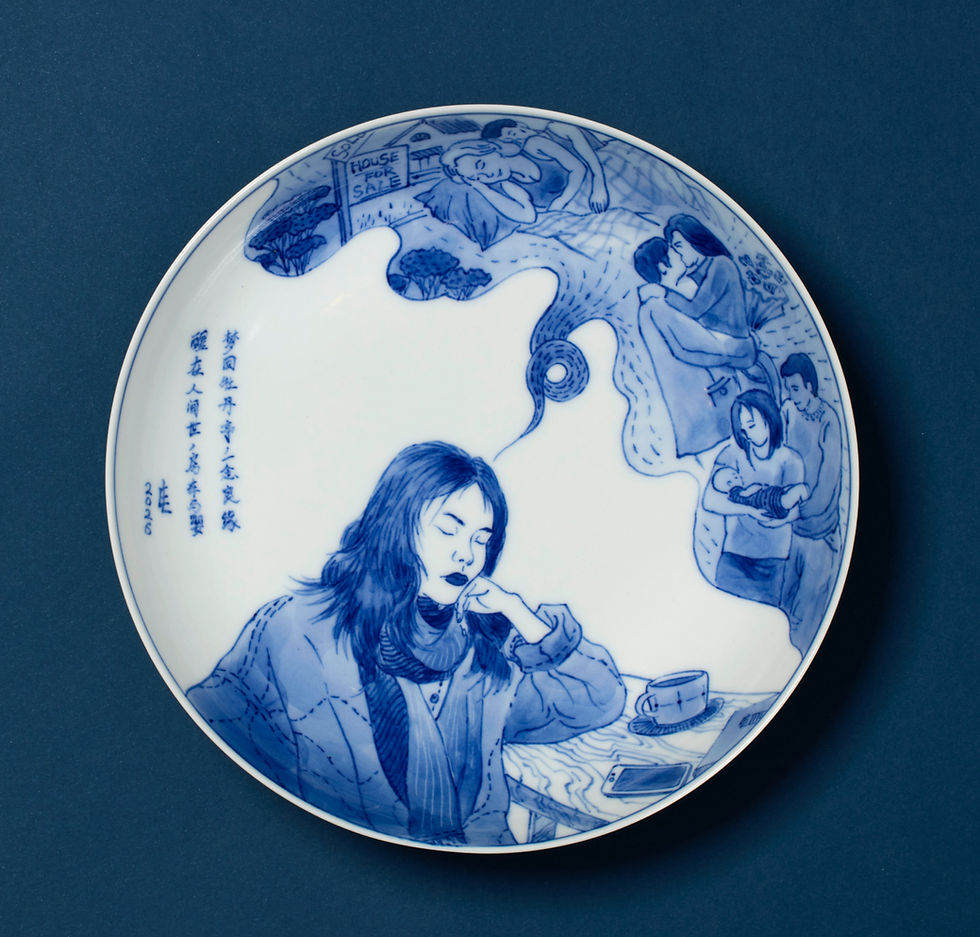
I began working on an etching of my friend Ariel, resting her head on her arm in a pose reminiscent of the original figure. Like Du Liniang, she was dreaming. But the content of that dream belonged to the present.
For many millennials, myself included, the pursuit of love is complicated by other anxieties. It is no longer enough to dream of finding someone. There is also the question of finding somewhere to live.
In London, where housing costs can make buying a home feel almost impossibly distant, how do you build a life together? People are getting married later, and finding a partner can feel increasingly difficult. Dating apps promise to make meeting someone easier, yet the experience can sometimes feel more like browsing a catalogue of people than falling into a romantic dream.
It is a far cry from the world of The Peony Pavilion, where desire and dreams are allowed to take centre stage.
I wanted my version of the scene to acknowledge these modern frustrations. The figure remained absorbed in a dream, but the dream itself had changed. Love was still there, but so were the practical obstacles to building a life around it.
I printed the etching in blue ink, deliberately evoking the familiar blue-and-white palette of Chinese porcelain. The connection between the print and the seventeenth-century dish was there, but something was missing. I wanted to bring the image back to the material that had inspired it in the first place.
I wanted to make it in porcelain.
A long way to Jingdezhen
At the time, I had no idea how to do it.
I had attended pottery classes, but we had never learnt about transferring designs onto ceramic surfaces. In any case, I was not sufficiently advanced as a potter to make the dish myself. I considered various possibilities, including transfer decoration, but eventually abandoned the idea.
Then I travelled to Jingdezhen, China's historic porcelain-producing centre.
There I met the potter Wu Xihong and his wife, Fang Fang. I visited their studio, where they showed me how to paint on porcelain. I found the process enormously enjoyable and experimented with a few designs of my own.
One day, I visited a street lined with shops selling ready-made ceramic vessels for people to decorate. Among the shelves of dishes, bowls and other forms, I spotted something extraordinary: a dish with almost exactly the same shape as the Shunzhi-period original.
I bought it immediately, intending to paint my design of the dreaming lady onto its surface.
There was just one problem. I had far too many ideas and far too little time. I was already busy developing my other ceramic designs, including brushpots decorated with elephants, and my time in Jingdezhen was running out. Eventually, I had to return to the UK, leaving the dish unfinished.
I was disappointed. After so many years, I had finally found the right object, only to discover that I couldn't complete it myself.
Fortunately, there was another possibility. I asked Fang Fang whether she might be able to reproduce my drawing on the dish and send it to me in Britain.
She agreed.
When the finished dish arrived, I was delighted. The design had finally found its way onto porcelain, reconnecting my contemporary interpretation with the seventeenth-century object that had first inspired it.
Ten years in a dream
Looking at the finished dish, I was struck by how long the journey had taken.
Almost ten years had passed since I first encountered the original in Dorset. In that time, an image that had begun as an art-historical interest had developed into a drawing, a woodblock print, an etching and finally a ceramic object.
The original Shunzhi-period dish had not changed, of course. What had changed was my relationship with it. At first, I had been captivated by its unusual composition and its place in the history of Chinese porcelain. Gradually, I became more interested in what the image could say to people living in the present.
The seventeenth-century heroine and the modern dreamer are separated by centuries, but both are caught between the life they have and the life they desire. The circumstances may differ, but the longing remains recognisable.
For me, this is one of the pleasures of working with historical art. It isn't simply a matter of copying an old design or reproducing an antique. It is about discovering what made an image compelling in the first place, and asking whether it can speak to us again in a different form.
The experience has also reinforced something I learnt on that first visit to the Butler collection. An object's significance cannot be reduced to its price. The market may determine what someone is willing to pay for a piece of porcelain at a particular moment, but it cannot tell us which object will capture our imagination, stay in our memory or inspire us to make something new.
I didn't choose the most expensive dish that day. I chose the one that spoke to me. Ten years later, it has become the starting point for a new work of my own.
Du Liniang's dream has travelled from a seventeenth-century Chinese dish, through the worlds of drawing and printmaking, to a contemporary ceramic made in Jingdezhen. Along the way, it has acquired a new set of anxieties, but it has never lost its central subject.
We still dream of love. We still dream of a home. And we still find ourselves wondering how to turn those dreams into reality.
Perhaps that is why I never forgot the dish I would have stolen.
My own interpretation, The Millennial's Dream, will be presented at my exhibition Edward Luper: Contemporary Ceramics at Bonhams, New Bond Street, from 1–4 November 2026.

Comments