

The Road to Laser Woodblocks III: Weight, Wood, and the First Doubts

There are moments in a project when something shifts from idea into reality. For me, that moment came on an ordinary lunch break. I went down to Bermondsey to collect the blocks.
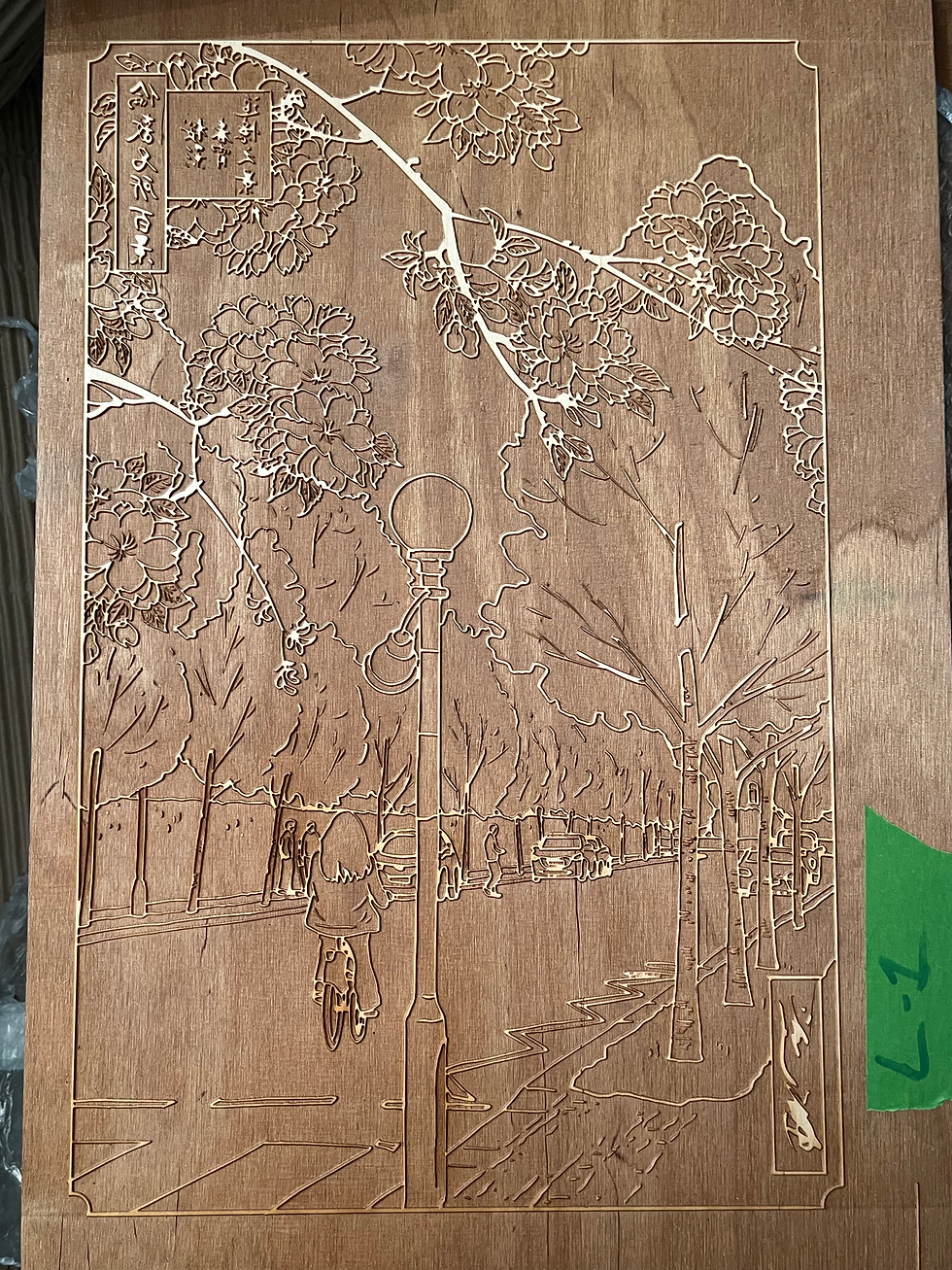
Stepping into the studio, I was immediately struck by the smell of wood: clean, warm, slightly sweet. It was unexpectedly moving. After months of drawing, planning, emailing, and second-guessing, here they were: twelve oban-sized blocks, stacked and waiting.
I picked them up. They were heavier than I expected...
Carrying them back through the heat, my arms began to ache almost immediately. Halfway through the walk I wondered whether I had been slightly overambitious: twelve blocks is not an idea, it is a physical commitment. By the time I got back, I was sweating profusely and my arms were on the verge of giving up. But I told myself, somewhat theatrically, that one must suffer a little for one’s art.
Back in the studio, I laid them out. That was when the scale of the project truly dawned on me. Up until that point, the work had lived mostly on a screen or on paper. Now it existed as twelve solid objects, each one demanding to be inked, aligned, and printed. And with that came a new set of problems I hadn’t fully appreciated before.

Paper. Pigment. Two simple words, deceptively simple.
Woodblock printing has a reputation for being straightforward. The basic principle is easy to grasp: ink the block, place the paper, rub, lift. But like many traditional processes, the simplicity is only on the surface. Every material introduces its own complexity.
I began with paper.
There are countless types of washi, each with different fibres, weights, and behaviours. I chose a kozo paper to start with. On paper (no pun intended), it seemed ideal: strong, traditional, widely used. But in practice, things were less straightforward. At oban size, once dampened, the sheet became surprisingly difficult to control. It softened, almost too much, and handling it, especially trying to register it accurately, proved more challenging than expected. What had seemed like a simple material suddenly required a sensitivity I didn’t yet have.
Then came pigments.
Here, too, I found myself caught between worlds. I could use Holbein, a Japanese brand, closer in spirit perhaps to the tradition I was trying to emulate, but the tubes were small, 15 ml, and not inexpensive. Or I could choose Winsor & Newton, made here, more readily available, and in larger 37 ml tubes: more practical, more economical.
In the end, I chose Winsor & Newton. It felt like a small but telling decision: this was not going to be a reconstruction of the past, but a negotiation with the present. But choosing the paints was only the beginning. How much to use? How much water? How much rice paste? The ratios are rarely written down in a way that truly helps. Everything seems to depend on feel: on experience I do not yet have.
And then there is gradation. That soft fading of colour, so effortless in the great prints, is in reality the result of extraordinary control. How wet is the brush? How loaded with pigment? How quickly must one work before the block dries? Already, before even attempting it, I can feel a certain hesitation creeping in.
A kind of quiet fear. Not of failure exactly, but of not yet understanding the language of the materials. What I’m beginning to realise is this: The principle of woodblock printing is simple.The practice is not.


Comments